
Define the conversion being quoted
An order for finished stud lengths should identify whether the proposed route starts with already qualified threaded stock or with material that requires further processing. Ask who performs cutting, end finishing and final identification, and what documentation covers those operations. ASTM A962/A962M supplies common requirements where invoked by the product specification. A material certificate attached to a stock bar does not, on its own, describe every operation or establish the conformity of each delivered component.
Require a continuous identity record
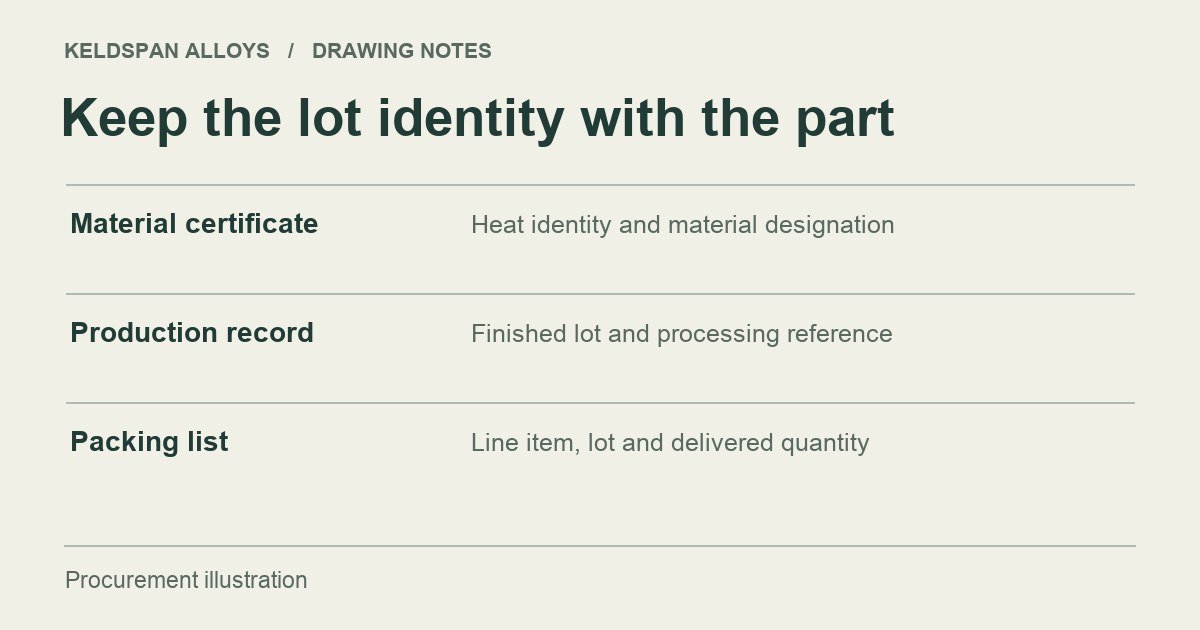
Request a transfer record that links the source heat and applicable lot to the cutting order, resulting lengths, quantities and shipping labels. Identify how remnants are segregated and retained if they may be used later. Portland Bolt's published cutting workflow illustrates recording heat identity when material is cut; the useful purchasing principle is a demonstrable link, not reliance on appearance. Ask for the proposed arrangement before source labels or original end markings are removed.
Address markings and processing changes
State the required final product markings and ask who is responsible for applying them under the ordered specification. Do not treat a reseller's packing label as an automatic replacement for required component identification. If cutting is followed by heat treatment, coating or other processing, request the relevant lot links and conformity records. Have any proposed marking exception reviewed explicitly. Alloy screening may assist identification, but it cannot reconstruct missing impact-test lineage or an undocumented processing history.
Use a simple reconciliation example
Suppose one purchase-order line draws finished studs from two source-stock lots. Ask for a cutting schedule that assigns each finished quantity to its original lot and corresponding reports, then verify that the packing list preserves that split. Reconcile shipped quantities with the schedule and document any remnants or rejected pieces. This creates a practical receiving check without requiring a new impact test merely because stock was shortened, or assuming that shortening alone resolves every finished-product requirement.